I feel like one advantage of being a noob in the art world is that I can frankly state my opinions on art matters and if more art-minded people disagree with it, my comments shouldn’t be that incensing due to my ignorance in these matters.
I felt compelled to start with that little reminder because today’s topic maybe a contentious one. I normally don’t appreciate most depictions of nudity in art, especially some of the more contemporary ones that I find just outright vulgar. When I read reviews on such artworks and find people who praise the artistic merit of it, I wonder what they’re snorting, because I don’t see how it’s different from porn.
Today I came across this presentation made by Miru Kim for TED talks:
I’m amazed by her work and her use of nudity to add value to what the photo has to say. Without her in the picture, it’s just a nicely composed photograph. I was surprised to find that I actually understood her intention of not bringing in clothes, which would carry connotations that she wanted to keep out. I loved how playful she became in the spaces with her poses, making her look like an ethereal creature. I valued her reflection on how quickly man-made things fall into disrepair as nature reclaims that space. Most of all, her demeanor during the presentation surprised me, she gave out a vibe that was almost shy or nervous, considering the nature of her work.
So yeah, TED talks, it’s pretty awesome, go watch their videos.

Monday, July 26, 2010

Such a feeling’s coming over me, there is wonder in most everything I see
As I was thinking of how to compose today’s blog post, the snippet of a song quoted in the title was stuck in my head. I thought it was by ABBA and I couldn’t really remember the lyrics properly so I spent half a day with the tune stuck in my head until I remembered that it is from Top of the World by the Carpenters. This discovery then led to more song flashbacks and before I knew it, I was rocking out to Jambalaya. O.o
Anyway, I attribute the reason for those words being stuck in my head in the first place was a tour we took earlier today.* At this point I should explain that the museum originally was made up of two villas that Sheikh Hassan used to house his collection of artworks and also to provide a studio for Arab artists to work in. When he donated his collection to Qatar Foundation, one of the villas was converted into office spaces for the staff, and this is where we are currently. Some of the artworks are being restored and are in the other building, while the other artworks that have already been stored and organized are kept in the two upmost floors of the office villa. So today, Michelle, the Head of Education, was taking a new staff on a tour of the two villas and took us interns along with them. (“Took us interns” Hah! Next thing you know I’ll be writing sentences that go: “It was them staff and us interns who went to that there room for a-meetin. Hey, that yonder painting’s katty-wonkered!”)
Since I moved to Qatar almost four years ago and seeing the initiatives being taken in education, sports, and arts, I keep getting the vibe that we are living in the midst of what will be a defining moment in the history of future generations. That vibe was present again today when Michelle reminded us that some of the artworks being painstakingly restored and organized in time for the museum’s opening probably were created here in the first place, when the villa was a studio. And wouldn’t-ya know it, I was googling around for the artist whose painting caught my attention during the tour and found this interview:

Which makes me wonder, were the people in the past who were responsible for creating some of the greatest artworks today aware that they were doing so? Unlike things like buildings where the architect has some idea of the impact his design will produce (It will be stackable, so that we can add floors to make sure it stays the tallest in the world! It will be the headquarters of the most awesomest organization ever! It will float on air!), artists might have a harder time predicting the impact of their work. I assume, though, that most artists don’t create things for other people, but more to simply express themselves and exercise their talent. Which would maybe explain why an artist’s studio can be incredibly messy with their works in various stages of completion strewn about with a seeming disregard for their care, and then years later, we find experts meticulously preserving or restoring those same artworks.
I think those artists have the right mindset, there’s no need to obsess about becoming the next great thing if you’re secure in the knowledge that you’re contributing to the overall greatness of humanity in general, while acting in accordance with the beliefs you profess. If what you do is worth commending, people will notice and it will be a really cool surprise for you when they do. As opposed to doing everything to be recognized and constantly bummed that you’re not getting the attention you feel you deserve.
----------
*This post was started last week so the “today” I’m referring to was actually last Wednesday, but I only got around to finishing this post today, which is why it’s posted today instead of last Wednesday, when the events that I talk about actually occurred. Confused? Maybe I should’ve just pretended it was today and spared myself writing, and you reading, this footnote that is turning into a paragraph.
Anyway, I attribute the reason for those words being stuck in my head in the first place was a tour we took earlier today.* At this point I should explain that the museum originally was made up of two villas that Sheikh Hassan used to house his collection of artworks and also to provide a studio for Arab artists to work in. When he donated his collection to Qatar Foundation, one of the villas was converted into office spaces for the staff, and this is where we are currently. Some of the artworks are being restored and are in the other building, while the other artworks that have already been stored and organized are kept in the two upmost floors of the office villa. So today, Michelle, the Head of Education, was taking a new staff on a tour of the two villas and took us interns along with them. (“Took us interns” Hah! Next thing you know I’ll be writing sentences that go: “It was them staff and us interns who went to that there room for a-meetin. Hey, that yonder painting’s katty-wonkered!”)
Since I moved to Qatar almost four years ago and seeing the initiatives being taken in education, sports, and arts, I keep getting the vibe that we are living in the midst of what will be a defining moment in the history of future generations. That vibe was present again today when Michelle reminded us that some of the artworks being painstakingly restored and organized in time for the museum’s opening probably were created here in the first place, when the villa was a studio. And wouldn’t-ya know it, I was googling around for the artist whose painting caught my attention during the tour and found this interview:
"I have been able, however, to put together some thoughts on the artist from a recorded interview that I conducted with him in his studio in Doha in 2002, as well as through the many conversations I had with him over the years, particularly in the mid-1990s when I used to meet with Fattah in the studio in Doha that the Arab Museum of Modern Art provided for him. It was there that he produced a collection of works that many believe best represents his achievements in both sculpture and painting."

Collection of Heads, by Ismael Fattah (from artnet.com)
Which makes me wonder, were the people in the past who were responsible for creating some of the greatest artworks today aware that they were doing so? Unlike things like buildings where the architect has some idea of the impact his design will produce (It will be stackable, so that we can add floors to make sure it stays the tallest in the world! It will be the headquarters of the most awesomest organization ever! It will float on air!), artists might have a harder time predicting the impact of their work. I assume, though, that most artists don’t create things for other people, but more to simply express themselves and exercise their talent. Which would maybe explain why an artist’s studio can be incredibly messy with their works in various stages of completion strewn about with a seeming disregard for their care, and then years later, we find experts meticulously preserving or restoring those same artworks.
I think those artists have the right mindset, there’s no need to obsess about becoming the next great thing if you’re secure in the knowledge that you’re contributing to the overall greatness of humanity in general, while acting in accordance with the beliefs you profess. If what you do is worth commending, people will notice and it will be a really cool surprise for you when they do. As opposed to doing everything to be recognized and constantly bummed that you’re not getting the attention you feel you deserve.
----------
*This post was started last week so the “today” I’m referring to was actually last Wednesday, but I only got around to finishing this post today, which is why it’s posted today instead of last Wednesday, when the events that I talk about actually occurred. Confused? Maybe I should’ve just pretended it was today and spared myself writing, and you reading, this footnote that is turning into a paragraph.
Tuesday, July 20, 2010
The Tangent Topic

(Tangents are fun, and if you say them often enough, they start to sound really strange.
Do it! Tangent, tangent, tangent, tangent…)
Do it! Tangent, tangent, tangent, tangent…)
Originally, I had planned a different topic for today’s blog post, but babbler that I am, I found myself going off on a tangent as I was actually writing it and found that I wrote more about the tangent subject rather than the main topic for the day. So, here is today’s blog post, a.k.a the tangent topic.
These days, I’ve been going through videos about Qatar’s history and development that Safya, the curator, and I got from Qatar TV. A major theme through most of them has been the progress of Qatar and heavily relies on stock clips of the Asian Games and Education City and the obligatory introductory sepia toned clips of people on boats or diving for pearls. There are a couple though, that are amazing in that they feature clips of everyday life in Qatar back in the day, including a game played by boys where they bury their heads in the sand. The narrative was in Arabic so I’m not exactly sure if I interpreted what was going on correctly but it really did seem like they were playing ostrich. Another CD documents the start of the petroleum industry, including the very first oil-related fire that took 15 days to put out.
As I watched and listened to the narratives talking about how Qatar progressed through the years, and the investments made by the Emir in health, education, culture, and economics, I remembered a presentation I worked on with a group from my Mapping Urbanism class about New York’s development. We learned about how the roads evolved from the winding paths that were formed based on the topography, until they were eventually replaced in the 1800s with the grid design we see today, with the exception of some of the original streets like Broadway, which deviate from the grid pattern.

(The plan for the grids to replace the original squiggly-er, topography-based tracks, called "cattle tracks." I think, or maybe it was "cow tracks?")
A few decades after the grid design was implemented, the population of New York exploded because of the wave of immigrants that came to America through New York. Apartments filled up the grids and often, they were cramped full of people, leaving them to seek cemeteries as open spaces to spend time in. Around this time, due to the economic progress enjoyed by the elite families in New York, they wanted an open space that they believed would liken New York to the major cities like London and Paris that had gorgeous public parks. This proposal led to Central Park.


(The Gates, an art installation by Christo and Jean-Claude in February 2005. The "gates" were saffron coloured fabric that hung throughout the lanes in Central Park, and were met with both admiration and ridicule.)
I kept fighting the urge to insert “sound familiar?” after every phrase in that previous paragraph. I don’t really know how to end this post, because a few similarities don’t merit a conclusion of “Doha is totally gonna be the NYC of the future!” I do think Qatar has enough vision to not desire to be just another major destination, to not be famous just for the sake of being famous. If Qatar reaches the heights it aspires for, it won’t be to become the New York, or the Paris, or the London of the Middle East, I think it will be its own icon.
Saturday, July 17, 2010
Interview with Rajeev, part 5 of 5.
This is the last of this series of posts. To end with, I asked him a couple of questions that hopefully says something more about him, compared to the previous, more industry-related questions.
What piece of art would you get personally, barring any financial constraints or space constraints or whatever?
That’s definitely a tough question because I feel as though the paintings that you would think of instantly like Van Gogh’s Starry Night, these have become so priceless and so omnipresent, it’s in college dorm posters, postcards, it’s like the actual object loses it’s meaning. I feel like it’s better that it stays in the museum for everyone to see, I don’t need to own it to have it in my room.
So the artwork that I would actually like to own, I think the only answer I can give is sometimes there are types or artists that I would love to start collecting that are still reasonable and if I had a little money I would love to have now because I know in ten or twenty years it will be astronomical. Most of them are Indian modern and contemporary because that is what I am a sort of budding expert on. There are certainly some sculptures I would love to own, by an artist called Subodh Gupta and his wife, Bharti Kher. Subodh Gupta works with pots and pans that you would find in the kitchen but he makes these amazing sculptures with them. And his wife, you know the Bindi, she arranges them in these amazing abstract works or in big third eye arrangements that are beautiful.


So for my last question I thought I’d be random and ask you: What would you do if you knew you could not fail?
If I could not fail… wow this is definitely a miss universe kind of question (laughs).
If I could not fail, what would I do? Hmm… well, aside from the schoolboy sports stuff…I don’t know. I think in a very humble way, I’d like to be able to write the greatest science fiction short story or book or something. Because I feel as though writing is the easiest thing to fail at, it’s so full of pitfalls, and to actually put something together, I would love to be able to do that. But that’s a distant second to all the schoolboy sports stories, you know like win Wimbledon or the World Cup.
Thursday, July 15, 2010
Interview with Rajeev, part 4 of 5.
Having never been to an auction before, my only exposure to this practice consists of antique shows on BBC, so I thought it would be interesting to ask him: What’s your most memorable auction, whether it was because of the specific artwork or just the general events surrounding it?
There was a Star Trek memorabilia auction, that was pretty cool, and I was enough of a geek to appreciate it. Christie’s announced that it was actually their highest online participation, and you can imagine why. Usually, with online bidding, they have it just to show that they are cutting edge, but everybody either bids over the phone or in person. But the Star Trek one, there were a lot of bids online.
Also, while I was in Christies the big sale of the year was of post war contemporary, and that’s when you get 10-20 million hammer price. There were certainly one or two works by Andy Warhol that fetched those prices, it was pretty exciting to see.
Sometimes it just boggles the mind that we think that a diamond ring or fancy car for tens of thousands of dollars is a staggering amount but we think an artist selling for 50 thousand dollars is reasonable in the art world. 50 thousand dollars is not a lot in the art world, it’s paper and paint and we are fine with that selling for 30-40 thousand, but that amount for a diamond ring or a fancy car we find astronomical. There’s this very strange disconnect at the auction between pricing and the object. So when we struggle with that reality and be at an auction and see the hammer go down on an oil on canvas for ten million dollars… even though the art side of you knows the value or can appreciate the history behind the painting, physically, it’s just an image and it’s staggering. There’s a magic to that.

No. 5, 1948 by Jason Pollock boasts the highest known price paid for a painting.
It sold for USD 140 million in 2006, which in 2010 inflation-adjusted price is USD 151.2 million, according to Wikipedia's List of Most Expensive Paintings article. The Mona Lisa was insured by the Louvre in 1962 for USD 100 million, which in 2010 inflation-adjusted price is USD 713 million. (!!!)
It sold for USD 140 million in 2006, which in 2010 inflation-adjusted price is USD 151.2 million, according to Wikipedia's List of Most Expensive Paintings article. The Mona Lisa was insured by the Louvre in 1962 for USD 100 million, which in 2010 inflation-adjusted price is USD 713 million. (!!!)
Wednesday, July 14, 2010
Interview with Rajeev, part 3 of 5.
After his experience in working with auction houses, Rajeev now works as an assistant curator here at the Arab Museum of Modern Art. For today’s blog, I’m posting his thoughts on working at a museum:

The museum world is something else entirely. When the economy is a mess, the museum is a very safe place to be. It’s not a profit institution so there’s no drive to make money and your job is not at risk you just have to be an expert or a scholar and be passionate about art and not worry about selling that object.
The curator at a museum is the one who has to put together the message or the idea behind the exhibition. The curator looks at the collection of the museum and thinks, what story can we tell with this and how do we present that. So it’s something very conceptual where it’s coming up with the idea, just sitting down and doing the research to then the hard brass tasks of physically putting the exhibiting together. The logistics of shipping the artwork, designing the space, what kind of pamphlets are we going to give out, what’s the audio tour going to sound like, publishing the catalogue, so the very physical things as well.
A huge problem that the museum world is facing is almost losing its authority as an academic institution and becoming more of like an amusement park. Museums used to be the place where they were the highest authority, a pool of academics and scholars and they researched everything and was very much like a temple. Now it’s devolving into this very fun family amusement center and it’s more about the cool café, the interactive stuff that it does, and all these other outside programming which didn’t use to be a part of the museum. But now it’s so competitive and such big money that if you have those things you’re going to have revenue from ticket sales, which before wasn’t the case, but now that’s a huge way for them to get funds.
Tuesday, July 13, 2010
Interview with Rajeev, part 2 of 5.
Here’s the continuation of yesterday’s post. After getting his masters at Christie’s, Rajeev worked at Saffron Art, an Indian auction house, based in Mumbai, with an office in New York. I asked him to talk about the world of auction houses:
It’s a fascinating world to be a specialist in an auction house, you do many different things, you have to know the market, you have to know the client, you have to know the art obviously, so it’s a good blend of a lot of different things, it’s very fast paced.
An auction house is a big player in the ecosystem that is the art world. In the art world you have all these different players that have their roles, and they all interact. So you have the artists, obviously making the work; galleries that represent the artist to sell the work; collectors who enjoy the work and own them. Then you have some of the big institutions, the museum, which is supposed to maintain an art collection for the public good, so it’s “in trust” for the people or for the nation. It could even be a private museum, which is a very big collector who has such a big collection that he can open a museum just to show the works that he owns. Then you have the auction house, which is, in a very abstract way, you could say, the means by which artwork changes hands. Because art is a funny thing, it’s a cultural object, it talks a lot about what the artist is or where the society that makes that artwork is, but it also has value, we pay obscene amounts of money for some of these artworks. Auction houses help artwork by driving up the price and collectors to rotate their collection so that they’re always making more money to buy more art, or raise capital to do other things. Usually, an artwork comes to auction through what they call the 3Ds. One is Death: so a collector dies, the rest of the family goes, “We have all these Picassos, we don’t like art, let’s sell them and get the millions and live well, great.” Then you have Divorce: the husband and wife, they fight over who owns the Picassos and get the money. Third, which is also very common, is Debt: a once very wealthy family has run out of money in the stock market but they still have this huge collection and the banks want the money so they have to liquidate their collection.
What happens is they agree to put the works up for auction, the auction houses then do all the marketing and the groundwork, so that when the work comes up for auction it can go for the highest price possible.
How NOT to bid at auction
(I googled, there is such a thing as "bidding off the wall," imagine that!)
(I googled, there is such a thing as "bidding off the wall," imagine that!)
Monday, July 12, 2010
Interview with Rajeev, part 1 of 5.
Last Thursday, I interviewed Rajeev, who is an assitant curator here at the Arab Museum of Modern Art. I’ve broken down the interview into 5 parts so that I can post one part each day starting with this one:
So I guess we’ll start off with your background like where you were born and raised, where you studied, your major, that kind of thing?
I was born India but I never lived there. I grew up in Hong Kong and then mostly Bangkok, and when I graduated high school in Bangkok I went to Clark University, which is outside Boston. I didn’t know what I wanted to do so I just did the default, which was economics. It wasn’t really very good but, anyway, graduated, and then tried to be a stockbroker for a little bit in New York and hated that. The thing was I needed a work visa to stay in the states so I was pretty willing to do any job to stay there, so when that didn’t work out I jumped ship and became a purchasing agent for a wholesaler and that’s just a fancy way of saying that I was in a cubicle crunching numbers, inventory management, for three years.

So I guess we’ll start off with your background like where you were born and raised, where you studied, your major, that kind of thing?
I was born India but I never lived there. I grew up in Hong Kong and then mostly Bangkok, and when I graduated high school in Bangkok I went to Clark University, which is outside Boston. I didn’t know what I wanted to do so I just did the default, which was economics. It wasn’t really very good but, anyway, graduated, and then tried to be a stockbroker for a little bit in New York and hated that. The thing was I needed a work visa to stay in the states so I was pretty willing to do any job to stay there, so when that didn’t work out I jumped ship and became a purchasing agent for a wholesaler and that’s just a fancy way of saying that I was in a cubicle crunching numbers, inventory management, for three years.
That’s what made me wake up and think to myself, “This is a safe job I have a work visa I could just stay here and be fine, or I could leave now before I get too comfortable and do what I really want to do and that’s when my aunt got me into this internship at a gallery in DC because that’s where I was then. I loved it, they were the ones that told me I could take my business background and instead of just going for an art history masters, get a masters degree at Christie’s or Sotheby’s, the auction houses. It’s a very exclusive, small program. I looked at both, and I liked Christie’s. I applied there, got in, and got my masters in the art market with Christie’s. So after that, I was in New York, which was fantastic, I was in Manhattan and so much of the art world happens there. In a lot of the courses, we studied the things on the slides and in the textbooks and then you could actually walk across the street and go to the museum and actually see it in person, which is very special.
Things I Learned Last Wednesday
I came in to the office expecting a normal day going through articles, browsing through interesting pieces, in the shelter of the air-conditioned room where the sunlight streams in through the windows and general peacefulness reigns. You know what I’m talking about, the kind of light and ambience that begs for a Morning Has Broken background music and natural light that would look amazing on your face if you were posing for a photo, or so I learned from Tyra. ;) Did I just admit to watching Americas Next Top Model on a public blog?
Anyway, I came in and learned that the other interns, Nasreen & Samee, were being taught how to make their own video blogs. I tagged along with them since I am supposed to be making one at the end of my internship as well. Orlando, the multimedia guy who just arrived in Doha a few days ago, was teaching us the basics of how to set things up. As a final test, we had to disassemble and reassemble the video equipment within a reasonable amount of time, which we failed at miserably. But onward and forward we went anyway, the next step was to go “outside” to actually start shooting the video. Now when they were talking about shooting “outside” I thought they meant the parking lot or the area right outside the building, so my initial thoughts were: “Ugh… It’s gonna be so humid out but dagnabbit, I’m a trooper and I’m going out there!” So out we walked, until I realized that Samee was walking up to his car, and at that point I felt compelled to clarify what the plan was. Apparently, they wanted to film on a location that had an Arabic vibe to it, so we were going to Cultural Village, which is some distance away from the AMOMA office. No one actually knew how to get there, but we were familiar with the general area and decided to just figure it out when we got there. After circling around for a bit, we found out that it was closed to the public so we headed on to the Pearl, since it was only a few minutes away from Cultural Village.

As we were driving through the Pearl, I remarked how I have always found it hard to appreciate the perfection of everything in it: the grass is too green, the exterior of the buildings are too clean, the luxury is too obvious, I feel like it tries too hard. I appreciate the simple and rustic beauty of the old forts and souks and I find it fake when they try to put a body of water where there isn’t supposed to be one, or land where there’s supposed to be water. To me, nature looks best when it’s left alone, or if a design works with it rather than fights against it.
Orlando, though, said something that added perspective. He pointed out that the pyramids and the Hanging Gardens of Babylon probably stuck out from the traditional architecture, environment, and culture, just as much as these new developments now are. I can imagine if I had lived during that time I probably would be shaking my head at it too and thinking about how distracting it was from the natural beauty around it and why oh why couldn’t they just leave nature alone. And yet, if the Hanging Gardens were still around now, visiting them would probably be at the top of my bucket list.

So I guess my point is not that I should reserve judgment for a few decades before I form an opinion, but that every moment can be an opportunity to learn something new. Last Wednesday, I learned how to set up a video and fiddle with zebra stripes and ND filters, and I learned a new perspective on looking at modern designs.
I also learned that filming with professional looking video equipment is much more likely to get the guards to ask if you have permission to shoot videos, after which we were very politely asked to leave the Education City Recreation Center. The Rec Center was our third failed location of the day, since we weren’t getting the background we wanted from The Pearl. We actually ended up filming inside the CMU-Q building (fourth time’s the charm!), which is about five minutes away from the AMOMA office after driving and walking around in very hot and humid weather all around Doha.

(Learning how to catch the light in a photo is just one of the many very important lessons a camera addict can learn from watching Tyra, another is the power to “smize.” Also, I bet you can’t count the number of times that word is mentioned in this clip.)
Anyway, I came in and learned that the other interns, Nasreen & Samee, were being taught how to make their own video blogs. I tagged along with them since I am supposed to be making one at the end of my internship as well. Orlando, the multimedia guy who just arrived in Doha a few days ago, was teaching us the basics of how to set things up. As a final test, we had to disassemble and reassemble the video equipment within a reasonable amount of time, which we failed at miserably. But onward and forward we went anyway, the next step was to go “outside” to actually start shooting the video. Now when they were talking about shooting “outside” I thought they meant the parking lot or the area right outside the building, so my initial thoughts were: “Ugh… It’s gonna be so humid out but dagnabbit, I’m a trooper and I’m going out there!” So out we walked, until I realized that Samee was walking up to his car, and at that point I felt compelled to clarify what the plan was. Apparently, they wanted to film on a location that had an Arabic vibe to it, so we were going to Cultural Village, which is some distance away from the AMOMA office. No one actually knew how to get there, but we were familiar with the general area and decided to just figure it out when we got there. After circling around for a bit, we found out that it was closed to the public so we headed on to the Pearl, since it was only a few minutes away from Cultural Village.

(The Pearl Qatar, although I find it much more reminiscent of an amoeba rather than a pearl, but I get how The Amoeba would be hard to work with in terms of marketing.)
As we were driving through the Pearl, I remarked how I have always found it hard to appreciate the perfection of everything in it: the grass is too green, the exterior of the buildings are too clean, the luxury is too obvious, I feel like it tries too hard. I appreciate the simple and rustic beauty of the old forts and souks and I find it fake when they try to put a body of water where there isn’t supposed to be one, or land where there’s supposed to be water. To me, nature looks best when it’s left alone, or if a design works with it rather than fights against it.
Orlando, though, said something that added perspective. He pointed out that the pyramids and the Hanging Gardens of Babylon probably stuck out from the traditional architecture, environment, and culture, just as much as these new developments now are. I can imagine if I had lived during that time I probably would be shaking my head at it too and thinking about how distracting it was from the natural beauty around it and why oh why couldn’t they just leave nature alone. And yet, if the Hanging Gardens were still around now, visiting them would probably be at the top of my bucket list.
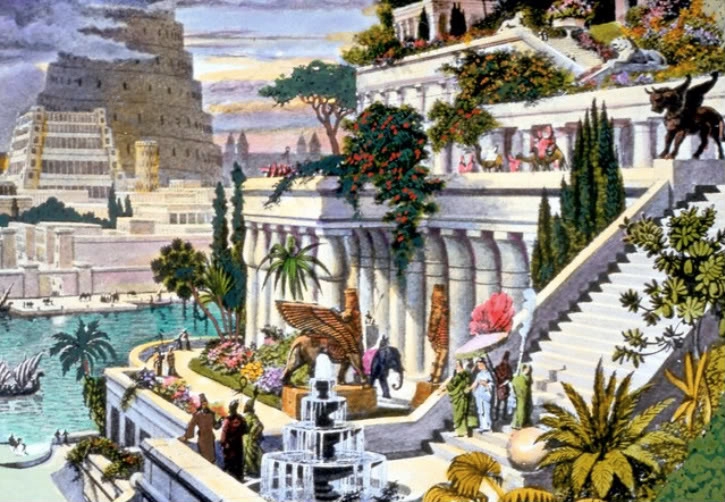
(Picture from Wikipedia: A 16th-century hand-colored engraving of the "Hanging Gardens of Babylon" by Dutch artist Martin Heemskerck, with the Tower of Babel in the background.)
So I guess my point is not that I should reserve judgment for a few decades before I form an opinion, but that every moment can be an opportunity to learn something new. Last Wednesday, I learned how to set up a video and fiddle with zebra stripes and ND filters, and I learned a new perspective on looking at modern designs.
I also learned that filming with professional looking video equipment is much more likely to get the guards to ask if you have permission to shoot videos, after which we were very politely asked to leave the Education City Recreation Center. The Rec Center was our third failed location of the day, since we weren’t getting the background we wanted from The Pearl. We actually ended up filming inside the CMU-Q building (fourth time’s the charm!), which is about five minutes away from the AMOMA office after driving and walking around in very hot and humid weather all around Doha.

(from left: Nasreen, Samee, me, and random dude who I hope doesn’t object to his picture being put up here, even though it would be really hard to recognize him from this.)
Wednesday, July 7, 2010
On Prettiness, Crudeness, and Art
It’s been a few days and I still catch myself from time to time responding to artworks with “prettyyyyy!” or “meh.” I know that some of them take on so much more meaning when you learn about the artist and their intentions with a particular piece, but sometimes I come across some of them that are just kind of hard to appreciate.

Art Asia Pacific did an article on Makoto Aida featuring some of his works, including the picture above scanned from the magazine. The article says that this work, entitled “Shit by Jomon-type Monster” was “intentionally crude” and an “embrace of failure.” “Jomon” is a pre-historic civilization from Japan. The article also talks about how the artist is capable of producing incredibly refined paintings, but is equally capable of producing sloppy drawings meant to parody Japan’s education system.
Lately, I’ve been trying to reflect on how I’ve defined art for the past years. There were works that I found simply beautiful, works that had interesting details or stories behind them to make up for the lack of “prettiness”, works that I found boring, and works that I disliked. Those in the last category, I chalked up as simply being too “avant-garde” for my understanding and left it at that.
 the beautiful (Starry Night Over The Rhone), the interesting (The Scream), the boring (Mona Lisa), and the disliked (The Persistence of Memory)
Spending time here, though, and being overwhelmed by such a huge variety of art, has led me to try to search for a better idea of what makes a work of art “good.” Sometimes I feel like people do outrageous and shocking things and then call it art for protection, because you can’t criticize “art”, or you look ignorant if you do, because art is whatever gets a reaction out of people. But is art really so subjective that anyone can call anything a good work of art?
While thinking about this, I remembered something that stuck with me from an Entrepreneurship class I took in university. (Yes, I am bringing up a business course in my blog about art, bear with me.)
My professor started by asking each of us our reasons for taking a class, and of course most people answered, because we wanted to start our own business in the future. He then corrected us by saying that pretty much anyone can start their own business, but not everyone can be an entrepreneur.
An entrepreneur adds value to the world and revolutionizes products or processes. He related the point using a scene from The Emperor’s Club, when the professor tells them about Shutruk-Nakhunte, the emperor who conquered a bunch of places but is unknown today because despite his accomplishments, he contributed nothing to humanity.
 "Great ambition and conquest without contribution is without significance." - The Emperor's Club
What I came away with is that good art, like a good business, should be innovative, it should explore an idea, a point of view, or a technique that’s never been done before. It should also add value; the world should seem a little bit better because of it, and a lot wanting without it.
That said, I take back what I said about the Mona Lisa being boring. ;)

Art Asia Pacific did an article on Makoto Aida featuring some of his works, including the picture above scanned from the magazine. The article says that this work, entitled “Shit by Jomon-type Monster” was “intentionally crude” and an “embrace of failure.” “Jomon” is a pre-historic civilization from Japan. The article also talks about how the artist is capable of producing incredibly refined paintings, but is equally capable of producing sloppy drawings meant to parody Japan’s education system.
Lately, I’ve been trying to reflect on how I’ve defined art for the past years. There were works that I found simply beautiful, works that had interesting details or stories behind them to make up for the lack of “prettiness”, works that I found boring, and works that I disliked. Those in the last category, I chalked up as simply being too “avant-garde” for my understanding and left it at that.
 the beautiful (Starry Night Over The Rhone), the interesting (The Scream), the boring (Mona Lisa), and the disliked (The Persistence of Memory)
Spending time here, though, and being overwhelmed by such a huge variety of art, has led me to try to search for a better idea of what makes a work of art “good.” Sometimes I feel like people do outrageous and shocking things and then call it art for protection, because you can’t criticize “art”, or you look ignorant if you do, because art is whatever gets a reaction out of people. But is art really so subjective that anyone can call anything a good work of art?
While thinking about this, I remembered something that stuck with me from an Entrepreneurship class I took in university. (Yes, I am bringing up a business course in my blog about art, bear with me.)
My professor started by asking each of us our reasons for taking a class, and of course most people answered, because we wanted to start our own business in the future. He then corrected us by saying that pretty much anyone can start their own business, but not everyone can be an entrepreneur.
An entrepreneur adds value to the world and revolutionizes products or processes. He related the point using a scene from The Emperor’s Club, when the professor tells them about Shutruk-Nakhunte, the emperor who conquered a bunch of places but is unknown today because despite his accomplishments, he contributed nothing to humanity.
 "Great ambition and conquest without contribution is without significance." - The Emperor's Club
What I came away with is that good art, like a good business, should be innovative, it should explore an idea, a point of view, or a technique that’s never been done before. It should also add value; the world should seem a little bit better because of it, and a lot wanting without it.
That said, I take back what I said about the Mona Lisa being boring. ;)
Subscribe to:
Comments (Atom)