
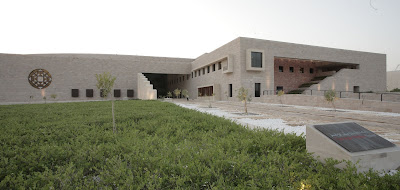
(Carnegie Mellon University in Qatar)
This summer I'm interning at the Arab Museum of Modern Art in Doha, Qatar. When it opens in December, I will get to say that I was part of the preparations, which I think is pretty cool. That's one of the few things that make this internship different from the other internships I've been on.
Another is that art has nothing to do with my major, neither is it something that I’ve expressed interest in the past. When I lived in DC, I had a friend who would drag me to the Smithsonian because she wanted to look at a painting. I would leave her staring in front of the painting while I wandered around a bit, and after a while I’d come back to find her sitting in the same position, still staring at the painting.

(Manhattan, 1932, by Georgia O’Keeffe)
It baffled me as to what could possibly be so interesting about it and I never asked for fear that she would spend the rest of the day talking about it. But as I flipped through art magazines last week, looking for interesting articles as part of my assignment, I realized, it doesn’t take too much effort to be able to find art relatable. There’s just so much of it that it’s impossible to not find something you like.
On the first day that AMOMA got some students together to discuss the possibilities of the summer internship, we were told that they wanted us to write a reflection on some topics that had to do with art in Qatar. I didn’t think I would have anything to write about, but then they showed us a video of some Qatari artists, and one in particular struck me. So for my first blog post, I thought I would share the reflection piece that I submitted, below:
"Does art have a role to play in the growth of our Region? If so, what role do you think the Arab Museum of Modern Art can play in Qatar?"
Allow me to tackle this question from a more personal point of view. In the Philippines, we're very proud of our 2000 year old rice terraces. These are basically rice paddies carved into the mountainsides, and kept irrigated by dams, channels, and bamboo pipes. These are built mainly by hand with a few primitive tools, and are considered a feat of engineering. The terraces need regular upkeep since they are easily eroded, and the skills are passed down from generation to generation. However, in recent years, many of the younger generations have given up their way of life to move to the cities and engage in more modern means of livelihood, putting the future of the terraces in danger. It is hard to blame them for wanting to explore other options, but it is disheartening to think of the possibility that someday, all we'll have left of these wonders are the photographs and paintings that seek to immortalize their majesty. The reason I bring this up in a reflection that is supposed to be about art in Qatar is because the similarity allowed me to understand the challenge felt by one of the Qatari artists featured in the video upon seeing the remains of a seaside village, abandoned by its inhabitants in search of a more modern way of life.

As the region continues to speedily develop, it is important for art to chronicle and celebrate what is happening around us. Art can pay homage to the greatness of the past, in hopes that the future and the present may recognize that the greatness they achieve is only made possible by the foundations laid by generations before them. The Arab Museum of Modern Art can serve as a reminder that even the present way of life will someday be part of history. It is important to chronicle, discuss, and celebrate now, so that present generations can add something to enrich the region's history when the tall buildings and reclaimed land have made way for something else in the distant future, just as the seaside villages have made way for the city we live in now.
Many years from now, I do hope that the rice terraces in the Philippines are preserved because people who appreciate it felt strongly enough to do something. Many of the individuals pushing for its preservation have probably never even been there to see it personally, like myself, but have been impassioned because of the beauty they see depicted by photographers, film makers, painters, etc. Many around the world may still be unable to locate Qatar on a map, but the beauty and the emotions conveyed by art is a step in the right direction towards making people take notice.

No comments:
Post a Comment