
Sunday, August 15, 2010

An Interview with Rasha from the Education team.....
- Why do you think the role of the interpretive materials coordinator is so important? What are your aims?
My job is to be a bridge between the curators and the audience. My role as an educator is to allow museum audiences to access big ideas behind the exhibition.
- What do you hope to achieve as interpretive materials co-coordinator?
I have to try and keep in line with how the museum sees itself. As an open space, where people can engage and interact. To create a creative hub for people so that they will want to come back to the museum. In my wildest success scenario people will feel connected to the museum through interpretive materials.
- What interpretive materials are you going to use?
The two projects I am working on now; the first is creating a guide for family’s. The idea is to help adults who are bringing children in to the gallery to talk about the art with them, and encourage them to engage with it. My job is to help them to have that conversation. This guide focuses on a specific work- just one piece in particular, because it is attractive and accessible.
And then I’m also working on a longer guide but the audience for this has not been determined yet. The goal for both is to help people engage with our collection.
- What are these guides going to do/contain?
They are going to highlight art pieces and with the families we are going to try and encourage them to look at something all together, and then we’ll tell them to go home and “try this”…whether it be to draw or make something out of clay. With our guides directed towards teens and younger adults, obviously we have to talk to them differently but we still want them to try the same things and encourage them to be creative themselves.
- Which audience do you think is most important to address?
Well…it’s not up to me to decide actually. But our niche is to target teens and young adults. In Doha there is a lack of space for people who are creative and people who want to experience something. Our purpose is to provide a space that doesn’t exist yet. Doha is transforming itself- education city is creating a college town but there is still no forum….no space for all the young creative people.
- What would you say if someone was to say that artworks should be left alone, and all the interpretive materials interfere and draw attention away from the actual artworks? Don’t people sometimes get distracted by additional materials?
Well What would be missing would be a different kind of engagement. It can’t just be about information…it’s about interaction on multiple levels. We have to think about what ways we can connect things and support different ways of learning. I think to be honest this argument is flawed. The way children learn for example is through touching and exploring. They need to play. In a museum you could have a forum where they can explore instead of just looking.
- Do you think adults are perhaps more likely to disregard interpretive materials?
Well what I’ve heard (anecdotally) is that adults often ignore the adult materials and pick out the children guides because they foster a sense of wonder and curiosity. What I hope to do differently is to help them access their own curiosity and wonder about art. But talking to adults is going to be interesting as it’s not in my past experience.
- What exactly is your background in education?
I taught middle and elementary school- in the states and in Egypt. In my teaching I would use art to help different kinds of learners. Everyone is realizing there is a need to move away from learning the same way. There are people who are visual and we have to make sure that everyone is achieving their potential. I used to teach literature through art.
- Will you go back to teaching?
This is a very interesting detour. Later I think I will go back to teaching.
- What are your future aims for the exhibition?
I’m shooting for the use of more multimedia materials and trying to figure out how to use more technology. But that takes a lot of time.
- How are you going to encourage people to respond to the exhibition?
I’m still determining what the best thing to do is. Whatever interpretive materials are used they must be there to help the audience decide for themselves how to move through the space, and how to digest everything.
Interpretive Materials
One of the aims of art museums and galleries like the DAM, is to reach out to their adult audience. When people think of interpretive materials in general they would normally associate them with children, or at least a younger audience. However, interpretive materials are striving to reach out to adults so that they too can broaden their experience at an art museum. They too are encouraged to interact with their creative side, and to try out new things so as to engage with the art more. The problem is trying to reach to an adult audience without them feeling uncomfortable with participating in “child like” activities. Museums thus have to be careful in choosing the right activities, and displaying them in the right kind of way so that adults are happy to participate. As discussed in “new angles of interpretation” the materials and the language used can make a big difference. For example, a leather bound book will do more to attract an adult to write their response rather than paper and coloured pens. Creating a space with obviously sized adult tables next to child tables and stools will also help people to recognize that all ages are invited to engage with interpretive materials. The language on the directions also has to be inviting and encouraging so as to make people feel comfortable. The findings of the study carried out by DAM that the words “tell us your story” rather than “tell us what you think about this” will encourage more response is very interesting. Similarly, adults are more likely to add their own response alongside an expert, if the experts tone is light and friendly. To perceive an artist or educator on a similar level to yourself will encourage response.
However, there still does appear to be some kind of hesitation in adults to join in with such activities other than perhaps reading labels and writing a few words in a guest book/journal. As New Angles states…“adult visitors just don’t expect to find activities geared towards them in a museum and aren’t quite sure what to do when they discover them”. I partly believe that adults aren’t really that willing to participate in certain activities simply because they aren’t that interested in doing so. Do they even really have the time to sit down at an interactive screen and pick out things to do, or sit down at a desk and make a postcard as was done at the DAM. Surely when visiting art museum adults simply want to look at the art, read some information, discuss it with their friends, and perhaps write something down in a response book at the most. Don’t some of these interpretive materials go too far in their expectations of what people want? They also seem to underestimate an adult audience’s ability to interact and engage with artworks by themselves. Do they really need all these other materials to really “feel” the emotions that are desired by the museum? If an artwork is going to stir up something inside you, it will by itself.
You could argue however that with those works which don’t immediately grab your attention, or interest you, engaging with it on another level (such as watching a video interview with the artist, or reading other visitors or experts responses), may help you to understand it more. You can at least attempt to acknowledge the artist’s creative process, but you probably won’t relate to it in any personal way.
I can’t help but feel that taken too far, interpretive materials try too hard to evoke a response in people. They could be distracting, and even the reports at the end of the article New angles… suggests that on average, participants who were asked to rate question labels, rated them with a pretty mediocre score. Similarly they had “similar results with iPods, with poetry and with the modern and contemporary labels” and yet they still think it’s worth doing because there is a small audience who really do enjoy using the materials and participating in the activities.
My overall impression of the aims of museum personnel is to turn the art museum into a new kind of environment. This environment is less concerned with the discipline of art history by itself, and more concerned with the culture of today, and their creative experiences and abilities. “to consider the physicality of art, in addition to its more cerebral aspects”. This may be suitable for a modern gallery, but to lose all focus of the actual art is a risk. Signals in the New angles article suggest this, especially when the master teachers Heather Nielsen and Lisa Steffen claim they don’t discount the value of any thoughtful response (in the visitor journals of their exhibitions)even if it has nothing to do with the art.
Because people often don’t notice certain labels, books, and activities designed for their use Museums are thinking up new ways to grab our attention through the use of noticeable signs, prompts, and instructions to direct us. This is where interpretive materials become intrusive and distracting. Shouldn’t we be directing ourselves through the space, and making our own choices? Even DAM admits “we haven’t hit on the right solution yet”.
Thursday, August 12, 2010
Interpreting Art
Yesterday, as I was checking out the page that the Ted Talks video of Miru Kim was on, I noticed that one of the comments from someone called Adi D was, “successful artwork is that which sparks the viewers interpretative imaginations – regardless of the original intention of the artist.”
Well, what about people like me, I ask? Normally, I can’t pull a coherent thought together about a work of art until I find out about its background.

Me: I lke it.
Voice in my head: What do you like about it?
Me: It’s very pretty.
My subconscious: Yes, but what makes it pretty?
Me: It’s… colorful?
Voice in my head: How do you find yourself reacting to the combination of colors? Does it incite serenity, happiness, triumph…?
Me: Yeah, sure, that’s it. Totally.
Voice in my head: Huh?
Me: (Frantically googling for info on the painting.) Ahem. Actually, I would like to add that I quite enjoy the artist’s portrayal of light, shadows, and forms. The painting also has a dimension that invites you to look closer, making it quite a meaningful experience. It conveys a message on the macro level that is quite aesthetically pleasing and yet, on a micro level, there are details to ponder on. It’s quite exquisite.
Voice in my head: Riiight.
Ignoring the disturbing realization that I’m very concerned with feigning intelligence to the voice in my head, I also apparently equate intelligence to excessive usage of the word “quite.” Seriously, though, I think some paintings do “speak” to me, it seems to be more an issue of me not being able to hold up my end of the conversation.

Take for example The Scream by Edvard Munch. At first glance, I find myself drawn to it and haunted by it, but for the life of me I can’t say what exactly about it interests me so much. In an effort to say something insightful all I manage to come up with is “Well, it’s kinda curvy, I mean fluid, I guess, it’s very fluid and at the same time its angular like its coming right at you but the back is very fluid and it kinda makes me feel like it comes right in my face and then it takes me and pulls me in until I feel like I’m at that dark edge of the painting so then I’m squinting at that spot trying to make out details or shapes in there.” Enter Wikipedia and this quote:
In a page in his diary headed Nice 22.01.1892, Munch described his inspiration for the image thus: I was walking along a path with two friends — the sun was setting — suddenly the sky turned blood red — I paused, feeling exhausted, and leaned on the fence — there was blood and tongues of fire above the blue-black fjord and the city — my friends walked on, and I stood there trembling with anxiety — and I sensed an infinite scream passing through nature.And it’s a total lightbulb moment, I say, “Duh! that’s what I meant!” So I guess, the first step in interpreting art is to spark a connection. I tried staring at Guernica by Picasso for a while because apparently it’s supper important, but for the life of me I cannot figure out what is going on with all those images, even with Wikipedia’s bullet-ed description. In this case, I think I’ll be better off internalizing the horrors of the Spanish Civil War from a history book than the painting.
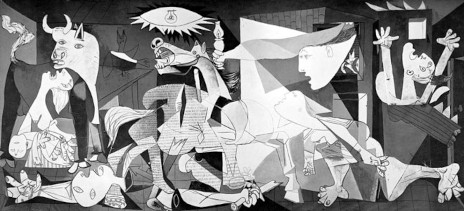
The second step is to have a conversation with it, and for some, it’s just a matter of being naturally eloquent/creative/imaginative/responsive. For others, like me, this requires some background reading to get things going. Thank God for Google.