
“A painting doesn't need anybody to explain what it is about. If it is any good, it speaks for itself." – Mark Rothko, abstract expressionist artist
Yesterday, as I was checking out the page that the Ted Talks video of Miru Kim was on, I noticed that one of the comments from someone called Adi D was, “successful artwork is that which sparks the viewers interpretative imaginations – regardless of the original intention of the artist.”
Well, what about people like me, I ask? Normally, I can’t pull a coherent thought together about a work of art until I find out about its background.

A Closer Grand Canyon by David Hockney
Me: I lke it.
Voice in my head: What do you like about it?
Me: It’s very pretty.
My subconscious: Yes, but what makes it pretty?
Me: It’s… colorful?
Voice in my head: How do you find yourself reacting to the combination of colors? Does it incite serenity, happiness, triumph…?
Me: Yeah, sure, that’s it. Totally.
Voice in my head: Huh?
Me: (Frantically googling for info on the painting.) Ahem. Actually, I would like to add that I quite enjoy the artist’s portrayal of light, shadows, and forms. The painting also has a dimension that invites you to look closer, making it quite a meaningful experience. It conveys a message on the macro level that is quite aesthetically pleasing and yet, on a micro level, there are details to ponder on. It’s quite exquisite.
Voice in my head: Riiight.
Ignoring the disturbing realization that I’m very concerned with feigning intelligence to the voice in my head, I also apparently equate intelligence to excessive usage of the word “quite.” Seriously, though, I think some paintings do “speak” to me, it seems to be more an issue of me not being able to hold up my end of the conversation.

Take for example The Scream by Edvard Munch. At first glance, I find myself drawn to it and haunted by it, but for the life of me I can’t say what exactly about it interests me so much. In an effort to say something insightful all I manage to come up with is “Well, it’s kinda curvy, I mean fluid, I guess, it’s very fluid and at the same time its angular like its coming right at you but the back is very fluid and it kinda makes me feel like it comes right in my face and then it takes me and pulls me in until I feel like I’m at that dark edge of the painting so then I’m squinting at that spot trying to make out details or shapes in there.” Enter Wikipedia and this quote:
In a page in his diary headed Nice 22.01.1892, Munch described his inspiration for the image thus: I was walking along a path with two friends — the sun was setting — suddenly the sky turned blood red — I paused, feeling exhausted, and leaned on the fence — there was blood and tongues of fire above the blue-black fjord and the city — my friends walked on, and I stood there trembling with anxiety — and I sensed an infinite scream passing through nature.And it’s a total lightbulb moment, I say, “Duh! that’s what I meant!” So I guess, the first step in interpreting art is to spark a connection. I tried staring at Guernica by Picasso for a while because apparently it’s supper important, but for the life of me I cannot figure out what is going on with all those images, even with Wikipedia’s bullet-ed description. In this case, I think I’ll be better off internalizing the horrors of the Spanish Civil War from a history book than the painting.
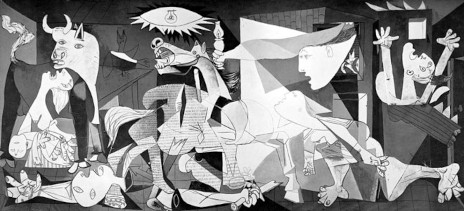
The second step is to have a conversation with it, and for some, it’s just a matter of being naturally eloquent/creative/imaginative/responsive. For others, like me, this requires some background reading to get things going. Thank God for Google.

No comments:
Post a Comment