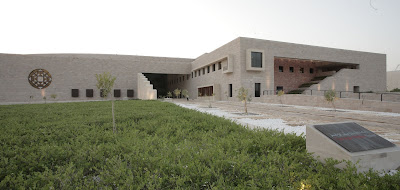
Shirin Neshat, a 53-year old Iranian visual artist, well-known for her works in film, video and photography, presented today at the Virginia Commonwealth University in Qatar. Her feature-film debut, "Women Without Men", will be screened tomorrow at Carnegie Mellon University in Qatar at 2:00 PM.
Sunday, October 24, 2010
Shirin Neshat in Qatar
Sunday, August 15, 2010
An Interview with Rasha from the Education team.....
- Why do you think the role of the interpretive materials coordinator is so important? What are your aims?
My job is to be a bridge between the curators and the audience. My role as an educator is to allow museum audiences to access big ideas behind the exhibition.
- What do you hope to achieve as interpretive materials co-coordinator?
I have to try and keep in line with how the museum sees itself. As an open space, where people can engage and interact. To create a creative hub for people so that they will want to come back to the museum. In my wildest success scenario people will feel connected to the museum through interpretive materials.
- What interpretive materials are you going to use?
The two projects I am working on now; the first is creating a guide for family’s. The idea is to help adults who are bringing children in to the gallery to talk about the art with them, and encourage them to engage with it. My job is to help them to have that conversation. This guide focuses on a specific work- just one piece in particular, because it is attractive and accessible.
And then I’m also working on a longer guide but the audience for this has not been determined yet. The goal for both is to help people engage with our collection.
- What are these guides going to do/contain?
They are going to highlight art pieces and with the families we are going to try and encourage them to look at something all together, and then we’ll tell them to go home and “try this”…whether it be to draw or make something out of clay. With our guides directed towards teens and younger adults, obviously we have to talk to them differently but we still want them to try the same things and encourage them to be creative themselves.
- Which audience do you think is most important to address?
Well…it’s not up to me to decide actually. But our niche is to target teens and young adults. In Doha there is a lack of space for people who are creative and people who want to experience something. Our purpose is to provide a space that doesn’t exist yet. Doha is transforming itself- education city is creating a college town but there is still no forum….no space for all the young creative people.
- What would you say if someone was to say that artworks should be left alone, and all the interpretive materials interfere and draw attention away from the actual artworks? Don’t people sometimes get distracted by additional materials?
Well What would be missing would be a different kind of engagement. It can’t just be about information…it’s about interaction on multiple levels. We have to think about what ways we can connect things and support different ways of learning. I think to be honest this argument is flawed. The way children learn for example is through touching and exploring. They need to play. In a museum you could have a forum where they can explore instead of just looking.
- Do you think adults are perhaps more likely to disregard interpretive materials?
Well what I’ve heard (anecdotally) is that adults often ignore the adult materials and pick out the children guides because they foster a sense of wonder and curiosity. What I hope to do differently is to help them access their own curiosity and wonder about art. But talking to adults is going to be interesting as it’s not in my past experience.
- What exactly is your background in education?
I taught middle and elementary school- in the states and in Egypt. In my teaching I would use art to help different kinds of learners. Everyone is realizing there is a need to move away from learning the same way. There are people who are visual and we have to make sure that everyone is achieving their potential. I used to teach literature through art.
- Will you go back to teaching?
This is a very interesting detour. Later I think I will go back to teaching.
- What are your future aims for the exhibition?
I’m shooting for the use of more multimedia materials and trying to figure out how to use more technology. But that takes a lot of time.
- How are you going to encourage people to respond to the exhibition?
I’m still determining what the best thing to do is. Whatever interpretive materials are used they must be there to help the audience decide for themselves how to move through the space, and how to digest everything.
Interpretive Materials
One of the aims of art museums and galleries like the DAM, is to reach out to their adult audience. When people think of interpretive materials in general they would normally associate them with children, or at least a younger audience. However, interpretive materials are striving to reach out to adults so that they too can broaden their experience at an art museum. They too are encouraged to interact with their creative side, and to try out new things so as to engage with the art more. The problem is trying to reach to an adult audience without them feeling uncomfortable with participating in “child like” activities. Museums thus have to be careful in choosing the right activities, and displaying them in the right kind of way so that adults are happy to participate. As discussed in “new angles of interpretation” the materials and the language used can make a big difference. For example, a leather bound book will do more to attract an adult to write their response rather than paper and coloured pens. Creating a space with obviously sized adult tables next to child tables and stools will also help people to recognize that all ages are invited to engage with interpretive materials. The language on the directions also has to be inviting and encouraging so as to make people feel comfortable. The findings of the study carried out by DAM that the words “tell us your story” rather than “tell us what you think about this” will encourage more response is very interesting. Similarly, adults are more likely to add their own response alongside an expert, if the experts tone is light and friendly. To perceive an artist or educator on a similar level to yourself will encourage response.
However, there still does appear to be some kind of hesitation in adults to join in with such activities other than perhaps reading labels and writing a few words in a guest book/journal. As New Angles states…“adult visitors just don’t expect to find activities geared towards them in a museum and aren’t quite sure what to do when they discover them”. I partly believe that adults aren’t really that willing to participate in certain activities simply because they aren’t that interested in doing so. Do they even really have the time to sit down at an interactive screen and pick out things to do, or sit down at a desk and make a postcard as was done at the DAM. Surely when visiting art museum adults simply want to look at the art, read some information, discuss it with their friends, and perhaps write something down in a response book at the most. Don’t some of these interpretive materials go too far in their expectations of what people want? They also seem to underestimate an adult audience’s ability to interact and engage with artworks by themselves. Do they really need all these other materials to really “feel” the emotions that are desired by the museum? If an artwork is going to stir up something inside you, it will by itself.
You could argue however that with those works which don’t immediately grab your attention, or interest you, engaging with it on another level (such as watching a video interview with the artist, or reading other visitors or experts responses), may help you to understand it more. You can at least attempt to acknowledge the artist’s creative process, but you probably won’t relate to it in any personal way.
I can’t help but feel that taken too far, interpretive materials try too hard to evoke a response in people. They could be distracting, and even the reports at the end of the article New angles… suggests that on average, participants who were asked to rate question labels, rated them with a pretty mediocre score. Similarly they had “similar results with iPods, with poetry and with the modern and contemporary labels” and yet they still think it’s worth doing because there is a small audience who really do enjoy using the materials and participating in the activities.
My overall impression of the aims of museum personnel is to turn the art museum into a new kind of environment. This environment is less concerned with the discipline of art history by itself, and more concerned with the culture of today, and their creative experiences and abilities. “to consider the physicality of art, in addition to its more cerebral aspects”. This may be suitable for a modern gallery, but to lose all focus of the actual art is a risk. Signals in the New angles article suggest this, especially when the master teachers Heather Nielsen and Lisa Steffen claim they don’t discount the value of any thoughtful response (in the visitor journals of their exhibitions)even if it has nothing to do with the art.
Because people often don’t notice certain labels, books, and activities designed for their use Museums are thinking up new ways to grab our attention through the use of noticeable signs, prompts, and instructions to direct us. This is where interpretive materials become intrusive and distracting. Shouldn’t we be directing ourselves through the space, and making our own choices? Even DAM admits “we haven’t hit on the right solution yet”.
Thursday, August 12, 2010
Interpreting Art
Yesterday, as I was checking out the page that the Ted Talks video of Miru Kim was on, I noticed that one of the comments from someone called Adi D was, “successful artwork is that which sparks the viewers interpretative imaginations – regardless of the original intention of the artist.”
Well, what about people like me, I ask? Normally, I can’t pull a coherent thought together about a work of art until I find out about its background.
Me: I lke it.
Voice in my head: What do you like about it?
Me: It’s very pretty.
My subconscious: Yes, but what makes it pretty?
Me: It’s… colorful?
Voice in my head: How do you find yourself reacting to the combination of colors? Does it incite serenity, happiness, triumph…?
Me: Yeah, sure, that’s it. Totally.
Voice in my head: Huh?
Me: (Frantically googling for info on the painting.) Ahem. Actually, I would like to add that I quite enjoy the artist’s portrayal of light, shadows, and forms. The painting also has a dimension that invites you to look closer, making it quite a meaningful experience. It conveys a message on the macro level that is quite aesthetically pleasing and yet, on a micro level, there are details to ponder on. It’s quite exquisite.
Voice in my head: Riiight.
Ignoring the disturbing realization that I’m very concerned with feigning intelligence to the voice in my head, I also apparently equate intelligence to excessive usage of the word “quite.” Seriously, though, I think some paintings do “speak” to me, it seems to be more an issue of me not being able to hold up my end of the conversation.
Take for example The Scream by Edvard Munch. At first glance, I find myself drawn to it and haunted by it, but for the life of me I can’t say what exactly about it interests me so much. In an effort to say something insightful all I manage to come up with is “Well, it’s kinda curvy, I mean fluid, I guess, it’s very fluid and at the same time its angular like its coming right at you but the back is very fluid and it kinda makes me feel like it comes right in my face and then it takes me and pulls me in until I feel like I’m at that dark edge of the painting so then I’m squinting at that spot trying to make out details or shapes in there.” Enter Wikipedia and this quote:
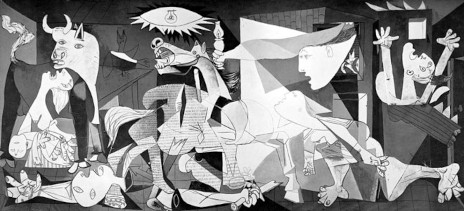
In a page in his diary headed Nice 22.01.1892, Munch described his inspiration for the image thus: I was walking along a path with two friends — the sun was setting — suddenly the sky turned blood red — I paused, feeling exhausted, and leaned on the fence — there was blood and tongues of fire above the blue-black fjord and the city — my friends walked on, and I stood there trembling with anxiety — and I sensed an infinite scream passing through nature.And it’s a total lightbulb moment, I say, “Duh! that’s what I meant!” So I guess, the first step in interpreting art is to spark a connection. I tried staring at Guernica by Picasso for a while because apparently it’s supper important, but for the life of me I cannot figure out what is going on with all those images, even with Wikipedia’s bullet-ed description. In this case, I think I’ll be better off internalizing the horrors of the Spanish Civil War from a history book than the painting.
The second step is to have a conversation with it, and for some, it’s just a matter of being naturally eloquent/creative/imaginative/responsive. For others, like me, this requires some background reading to get things going. Thank God for Google.
Monday, July 26, 2010
For once, I don't object
I felt compelled to start with that little reminder because today’s topic maybe a contentious one. I normally don’t appreciate most depictions of nudity in art, especially some of the more contemporary ones that I find just outright vulgar. When I read reviews on such artworks and find people who praise the artistic merit of it, I wonder what they’re snorting, because I don’t see how it’s different from porn.
Today I came across this presentation made by Miru Kim for TED talks:
I’m amazed by her work and her use of nudity to add value to what the photo has to say. Without her in the picture, it’s just a nicely composed photograph. I was surprised to find that I actually understood her intention of not bringing in clothes, which would carry connotations that she wanted to keep out. I loved how playful she became in the spaces with her poses, making her look like an ethereal creature. I valued her reflection on how quickly man-made things fall into disrepair as nature reclaims that space. Most of all, her demeanor during the presentation surprised me, she gave out a vibe that was almost shy or nervous, considering the nature of her work.
So yeah, TED talks, it’s pretty awesome, go watch their videos.
Such a feeling’s coming over me, there is wonder in most everything I see
Anyway, I attribute the reason for those words being stuck in my head in the first place was a tour we took earlier today.* At this point I should explain that the museum originally was made up of two villas that Sheikh Hassan used to house his collection of artworks and also to provide a studio for Arab artists to work in. When he donated his collection to Qatar Foundation, one of the villas was converted into office spaces for the staff, and this is where we are currently. Some of the artworks are being restored and are in the other building, while the other artworks that have already been stored and organized are kept in the two upmost floors of the office villa. So today, Michelle, the Head of Education, was taking a new staff on a tour of the two villas and took us interns along with them. (“Took us interns” Hah! Next thing you know I’ll be writing sentences that go: “It was them staff and us interns who went to that there room for a-meetin. Hey, that yonder painting’s katty-wonkered!”)
Since I moved to Qatar almost four years ago and seeing the initiatives being taken in education, sports, and arts, I keep getting the vibe that we are living in the midst of what will be a defining moment in the history of future generations. That vibe was present again today when Michelle reminded us that some of the artworks being painstakingly restored and organized in time for the museum’s opening probably were created here in the first place, when the villa was a studio. And wouldn’t-ya know it, I was googling around for the artist whose painting caught my attention during the tour and found this interview:
"I have been able, however, to put together some thoughts on the artist from a recorded interview that I conducted with him in his studio in Doha in 2002, as well as through the many conversations I had with him over the years, particularly in the mid-1990s when I used to meet with Fattah in the studio in Doha that the Arab Museum of Modern Art provided for him. It was there that he produced a collection of works that many believe best represents his achievements in both sculpture and painting."
Which makes me wonder, were the people in the past who were responsible for creating some of the greatest artworks today aware that they were doing so? Unlike things like buildings where the architect has some idea of the impact his design will produce (It will be stackable, so that we can add floors to make sure it stays the tallest in the world! It will be the headquarters of the most awesomest organization ever! It will float on air!), artists might have a harder time predicting the impact of their work. I assume, though, that most artists don’t create things for other people, but more to simply express themselves and exercise their talent. Which would maybe explain why an artist’s studio can be incredibly messy with their works in various stages of completion strewn about with a seeming disregard for their care, and then years later, we find experts meticulously preserving or restoring those same artworks.
I think those artists have the right mindset, there’s no need to obsess about becoming the next great thing if you’re secure in the knowledge that you’re contributing to the overall greatness of humanity in general, while acting in accordance with the beliefs you profess. If what you do is worth commending, people will notice and it will be a really cool surprise for you when they do. As opposed to doing everything to be recognized and constantly bummed that you’re not getting the attention you feel you deserve.
----------
*This post was started last week so the “today” I’m referring to was actually last Wednesday, but I only got around to finishing this post today, which is why it’s posted today instead of last Wednesday, when the events that I talk about actually occurred. Confused? Maybe I should’ve just pretended it was today and spared myself writing, and you reading, this footnote that is turning into a paragraph.
Tuesday, July 20, 2010
The Tangent Topic
Do it! Tangent, tangent, tangent, tangent…)
Originally, I had planned a different topic for today’s blog post, but babbler that I am, I found myself going off on a tangent as I was actually writing it and found that I wrote more about the tangent subject rather than the main topic for the day. So, here is today’s blog post, a.k.a the tangent topic.
These days, I’ve been going through videos about Qatar’s history and development that Safya, the curator, and I got from Qatar TV. A major theme through most of them has been the progress of Qatar and heavily relies on stock clips of the Asian Games and Education City and the obligatory introductory sepia toned clips of people on boats or diving for pearls. There are a couple though, that are amazing in that they feature clips of everyday life in Qatar back in the day, including a game played by boys where they bury their heads in the sand. The narrative was in Arabic so I’m not exactly sure if I interpreted what was going on correctly but it really did seem like they were playing ostrich. Another CD documents the start of the petroleum industry, including the very first oil-related fire that took 15 days to put out.
As I watched and listened to the narratives talking about how Qatar progressed through the years, and the investments made by the Emir in health, education, culture, and economics, I remembered a presentation I worked on with a group from my Mapping Urbanism class about New York’s development. We learned about how the roads evolved from the winding paths that were formed based on the topography, until they were eventually replaced in the 1800s with the grid design we see today, with the exception of some of the original streets like Broadway, which deviate from the grid pattern.
A few decades after the grid design was implemented, the population of New York exploded because of the wave of immigrants that came to America through New York. Apartments filled up the grids and often, they were cramped full of people, leaving them to seek cemeteries as open spaces to spend time in. Around this time, due to the economic progress enjoyed by the elite families in New York, they wanted an open space that they believed would liken New York to the major cities like London and Paris that had gorgeous public parks. This proposal led to Central Park.
Saturday, July 17, 2010
Interview with Rajeev, part 5 of 5.
Thursday, July 15, 2010
Interview with Rajeev, part 4 of 5.
It sold for USD 140 million in 2006, which in 2010 inflation-adjusted price is USD 151.2 million, according to Wikipedia's List of Most Expensive Paintings article. The Mona Lisa was insured by the Louvre in 1962 for USD 100 million, which in 2010 inflation-adjusted price is USD 713 million. (!!!)
Wednesday, July 14, 2010
Interview with Rajeev, part 3 of 5.
Tuesday, July 13, 2010
Interview with Rajeev, part 2 of 5.
(I googled, there is such a thing as "bidding off the wall," imagine that!)
Monday, July 12, 2010
Interview with Rajeev, part 1 of 5.
So I guess we’ll start off with your background like where you were born and raised, where you studied, your major, that kind of thing?
I was born India but I never lived there. I grew up in Hong Kong and then mostly Bangkok, and when I graduated high school in Bangkok I went to Clark University, which is outside Boston. I didn’t know what I wanted to do so I just did the default, which was economics. It wasn’t really very good but, anyway, graduated, and then tried to be a stockbroker for a little bit in New York and hated that. The thing was I needed a work visa to stay in the states so I was pretty willing to do any job to stay there, so when that didn’t work out I jumped ship and became a purchasing agent for a wholesaler and that’s just a fancy way of saying that I was in a cubicle crunching numbers, inventory management, for three years.
Things I Learned Last Wednesday
Anyway, I came in and learned that the other interns, Nasreen & Samee, were being taught how to make their own video blogs. I tagged along with them since I am supposed to be making one at the end of my internship as well. Orlando, the multimedia guy who just arrived in Doha a few days ago, was teaching us the basics of how to set things up. As a final test, we had to disassemble and reassemble the video equipment within a reasonable amount of time, which we failed at miserably. But onward and forward we went anyway, the next step was to go “outside” to actually start shooting the video. Now when they were talking about shooting “outside” I thought they meant the parking lot or the area right outside the building, so my initial thoughts were: “Ugh… It’s gonna be so humid out but dagnabbit, I’m a trooper and I’m going out there!” So out we walked, until I realized that Samee was walking up to his car, and at that point I felt compelled to clarify what the plan was. Apparently, they wanted to film on a location that had an Arabic vibe to it, so we were going to Cultural Village, which is some distance away from the AMOMA office. No one actually knew how to get there, but we were familiar with the general area and decided to just figure it out when we got there. After circling around for a bit, we found out that it was closed to the public so we headed on to the Pearl, since it was only a few minutes away from Cultural Village.
As we were driving through the Pearl, I remarked how I have always found it hard to appreciate the perfection of everything in it: the grass is too green, the exterior of the buildings are too clean, the luxury is too obvious, I feel like it tries too hard. I appreciate the simple and rustic beauty of the old forts and souks and I find it fake when they try to put a body of water where there isn’t supposed to be one, or land where there’s supposed to be water. To me, nature looks best when it’s left alone, or if a design works with it rather than fights against it.
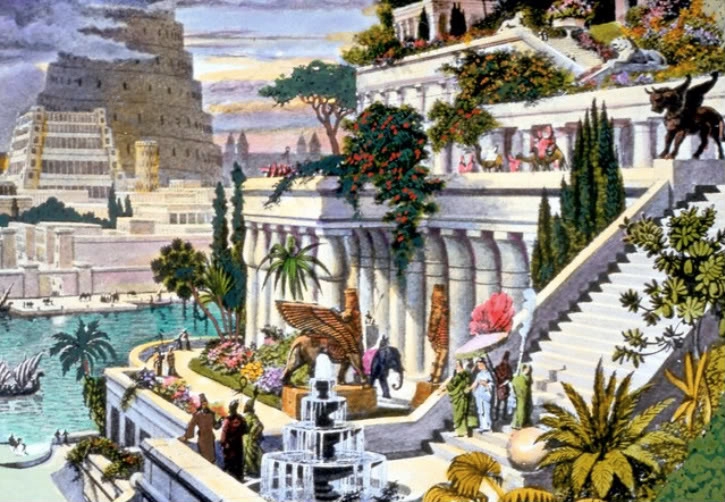
Orlando, though, said something that added perspective. He pointed out that the pyramids and the Hanging Gardens of Babylon probably stuck out from the traditional architecture, environment, and culture, just as much as these new developments now are. I can imagine if I had lived during that time I probably would be shaking my head at it too and thinking about how distracting it was from the natural beauty around it and why oh why couldn’t they just leave nature alone. And yet, if the Hanging Gardens were still around now, visiting them would probably be at the top of my bucket list.
So I guess my point is not that I should reserve judgment for a few decades before I form an opinion, but that every moment can be an opportunity to learn something new. Last Wednesday, I learned how to set up a video and fiddle with zebra stripes and ND filters, and I learned a new perspective on looking at modern designs.
I also learned that filming with professional looking video equipment is much more likely to get the guards to ask if you have permission to shoot videos, after which we were very politely asked to leave the Education City Recreation Center. The Rec Center was our third failed location of the day, since we weren’t getting the background we wanted from The Pearl. We actually ended up filming inside the CMU-Q building (fourth time’s the charm!), which is about five minutes away from the AMOMA office after driving and walking around in very hot and humid weather all around Doha.

Wednesday, July 7, 2010
On Prettiness, Crudeness, and Art

Art Asia Pacific did an article on Makoto Aida featuring some of his works, including the picture above scanned from the magazine. The article says that this work, entitled “Shit by Jomon-type Monster” was “intentionally crude” and an “embrace of failure.” “Jomon” is a pre-historic civilization from Japan. The article also talks about how the artist is capable of producing incredibly refined paintings, but is equally capable of producing sloppy drawings meant to parody Japan’s education system.
Lately, I’ve been trying to reflect on how I’ve defined art for the past years. There were works that I found simply beautiful, works that had interesting details or stories behind them to make up for the lack of “prettiness”, works that I found boring, and works that I disliked. Those in the last category, I chalked up as simply being too “avant-garde” for my understanding and left it at that.
the beautiful (Starry Night Over The Rhone), the interesting (The Scream), the boring (Mona Lisa), and the disliked (The Persistence of Memory)Spending time here, though, and being overwhelmed by such a huge variety of art, has led me to try to search for a better idea of what makes a work of art “good.” Sometimes I feel like people do outrageous and shocking things and then call it art for protection, because you can’t criticize “art”, or you look ignorant if you do, because art is whatever gets a reaction out of people. But is art really so subjective that anyone can call anything a good work of art?
While thinking about this, I remembered something that stuck with me from an Entrepreneurship class I took in university. (Yes, I am bringing up a business course in my blog about art, bear with me.)
My professor started by asking each of us our reasons for taking a class, and of course most people answered, because we wanted to start our own business in the future. He then corrected us by saying that pretty much anyone can start their own business, but not everyone can be an entrepreneur.
An entrepreneur adds value to the world and revolutionizes products or processes. He related the point using a scene from The Emperor’s Club, when the professor tells them about Shutruk-Nakhunte, the emperor who conquered a bunch of places but is unknown today because despite his accomplishments, he contributed nothing to humanity.
What I came away with is that good art, like a good business, should be innovative, it should explore an idea, a point of view, or a technique that’s never been done before. It should also add value; the world should seem a little bit better because of it, and a lot wanting without it.
That said, I take back what I said about the Mona Lisa being boring. ;)
Wednesday, June 30, 2010
First blog.

This summer I'm interning at the Arab Museum of Modern Art in Doha, Qatar. When it opens in December, I will get to say that I was part of the preparations, which I think is pretty cool. That's one of the few things that make this internship different from the other internships I've been on.
Another is that art has nothing to do with my major, neither is it something that I’ve expressed interest in the past. When I lived in DC, I had a friend who would drag me to the Smithsonian because she wanted to look at a painting. I would leave her staring in front of the painting while I wandered around a bit, and after a while I’d come back to find her sitting in the same position, still staring at the painting.
It baffled me as to what could possibly be so interesting about it and I never asked for fear that she would spend the rest of the day talking about it. But as I flipped through art magazines last week, looking for interesting articles as part of my assignment, I realized, it doesn’t take too much effort to be able to find art relatable. There’s just so much of it that it’s impossible to not find something you like.
On the first day that AMOMA got some students together to discuss the possibilities of the summer internship, we were told that they wanted us to write a reflection on some topics that had to do with art in Qatar. I didn’t think I would have anything to write about, but then they showed us a video of some Qatari artists, and one in particular struck me. So for my first blog post, I thought I would share the reflection piece that I submitted, below:
"Does art have a role to play in the growth of our Region? If so, what role do you think the Arab Museum of Modern Art can play in Qatar?"
Allow me to tackle this question from a more personal point of view. In the Philippines, we're very proud of our 2000 year old rice terraces. These are basically rice paddies carved into the mountainsides, and kept irrigated by dams, channels, and bamboo pipes. These are built mainly by hand with a few primitive tools, and are considered a feat of engineering. The terraces need regular upkeep since they are easily eroded, and the skills are passed down from generation to generation. However, in recent years, many of the younger generations have given up their way of life to move to the cities and engage in more modern means of livelihood, putting the future of the terraces in danger. It is hard to blame them for wanting to explore other options, but it is disheartening to think of the possibility that someday, all we'll have left of these wonders are the photographs and paintings that seek to immortalize their majesty. The reason I bring this up in a reflection that is supposed to be about art in Qatar is because the similarity allowed me to understand the challenge felt by one of the Qatari artists featured in the video upon seeing the remains of a seaside village, abandoned by its inhabitants in search of a more modern way of life.
As the region continues to speedily develop, it is important for art to chronicle and celebrate what is happening around us. Art can pay homage to the greatness of the past, in hopes that the future and the present may recognize that the greatness they achieve is only made possible by the foundations laid by generations before them. The Arab Museum of Modern Art can serve as a reminder that even the present way of life will someday be part of history. It is important to chronicle, discuss, and celebrate now, so that present generations can add something to enrich the region's history when the tall buildings and reclaimed land have made way for something else in the distant future, just as the seaside villages have made way for the city we live in now.
Many years from now, I do hope that the rice terraces in the Philippines are preserved because people who appreciate it felt strongly enough to do something. Many of the individuals pushing for its preservation have probably never even been there to see it personally, like myself, but have been impassioned because of the beauty they see depicted by photographers, film makers, painters, etc. Many around the world may still be unable to locate Qatar on a map, but the beauty and the emotions conveyed by art is a step in the right direction towards making people take notice.